
Wrapping machines do more than hold a product in place. They protect cartons from scuffs, bundle bottles for transport, and help keep pallet loads stable. The right system can also reduce repetitive handling on a busy line. But there is no universal choice. Product shape, film type, output speed, and available floor space all matter.
Grand View Research estimated the global packaging machinery market at USD 45.7 billion in 2023, with continued growth projected through 2030. That figure covers more than wrapping equipment, so it should not be read as a wrapping-machine market size. Still, it shows the scale of investment in packaging automation. PMMI’s industry research also highlights ongoing interest in automation and equipment flexibility as manufacturers respond to labor and production demands. These reports offer useful context, not a substitute for checking a machine against real operating conditions.
This guide compares the top types of Wraping Machine, from stretch and shrink systems to flow wrappers and case wrappers. Each handles a different job. A pallet wrapper may secure stacked loads with rotating film, while a flow wrapper seals individual products in a tight package. Small details count. Film changes, cleaning access, and changeover time can affect daily performance. Some machines look similar in a brochure. On the factory floor, they may behave very differently. We’ll look at how each type works, where it fits, and what buyers should verify before choosing one.
Powered stretch wrappers mechanically elongate film before it reaches the load. Industry specifications commonly place pre-stretch around 200–300%. At 200%, 100 metres of film becomes 300 metres; at 300%, it becomes 400 metres, assuming the percentage means extension beyond the original length. That matters. The calculation shows potential film yield, not guaranteed savings: overlap, film recovery, and load shape affect actual use. ASTM D4649, a technical guide for selecting and using stretch wrap films, supports evaluating film performance against the load and application rather than relying on stretch percentage alone.
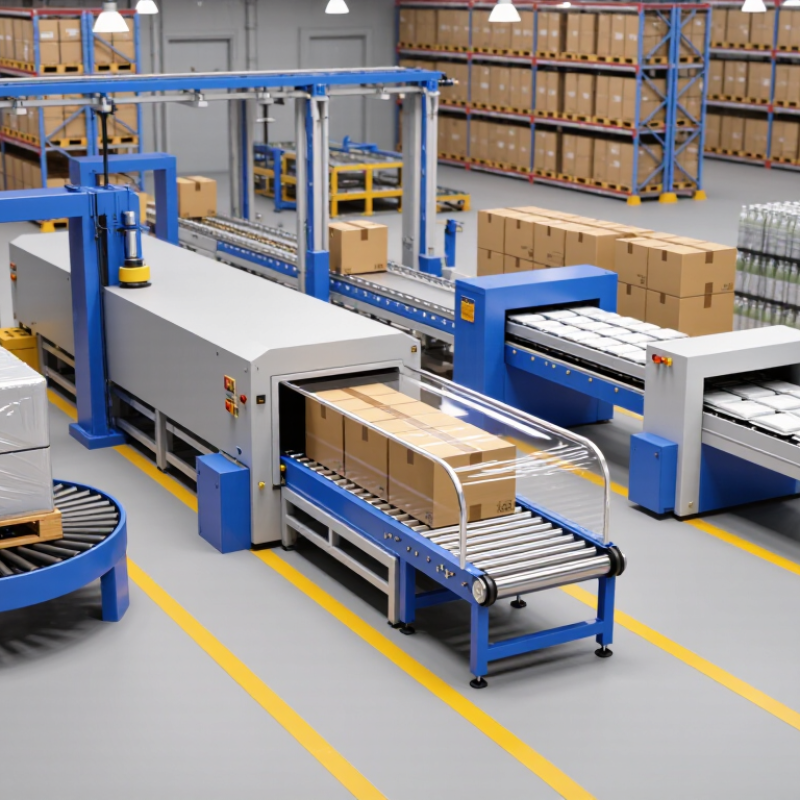
On a warehouse floor, the difference is visible in the film carriage: powered rollers stretch the web before it tightens around a pallet. A properly tuned machine can reduce film consumption while keeping cartons stable during handling. Too much stretch, however, can narrow or tear the web, especially at sharp corners. Operators should check the film’s tension, the pallet’s stability, and the number of wrap layers. ASTM D5458 describes a test method for measuring stretch-film cling, one factor in how layers hold together. Real results still vary. A neat specification sheet can make the machine look more efficient than it is in daily use.
| Machine Type | How It Wraps | Typical Applications | Pre-Stretch and Film Notes | Key Consideration |
|---|---|---|---|---|
| Turntable Stretch Wrapper | The load rotates on a powered turntable while the film carriage travels up and down. | Stable, palletized loads in low- to high-volume operations. | Powered pre-stretch systems commonly reach 200–300%; actual results depend on film and settings. | The load rotates, so this type may be unsuitable for very light, unstable, or easily tipped loads. |
| Rotary-Arm Stretch Wrapper | A rotating arm carries the film around a stationary load. | Tall, heavy, or unstable loads, and production lines where the load should remain stationary. | Powered pre-stretch is available; the achievable ratio varies by equipment configuration and film. | Requires adequate clearance for the rotating arm and appropriate guarding. |
| Rotary-Ring Stretch Wrapper | A ring or orbital carriage moves the film around the load, often on a continuous conveyor. | High-throughput lines and loads that benefit from controlled, continuous wrapping. | Powered pre-stretch may be used; settings are selected to balance containment, film use, and load stability. | Typically involves a larger investment and more integration with conveyor systems. |
| Horizontal Orbital Stretch Wrapper | A film ring rotates around a product moving horizontally through the wrapping area. | Long, narrow products such as pipes, profiles, lumber bundles, and furniture components. | Film type and tension are chosen for product shape and protection needs; pre-stretch capability depends on the model. | Designed for elongated products rather than standard pallet loads. |
| Vertical Stretch Wrapper | Film is applied around a product or bundle using a vertical wrapping arrangement. | Mattresses, doors, panels, and other large flat or upright products. | Film delivery and tension are matched to product dimensions and required restraint. | The product’s dimensions and support requirements determine the suitable configuration. |
| Manual or Mobile Stretch Wrapper | An operator applies film by hand or guides a mobile dispenser around a stationary load. | Low-volume work, irregular locations, or loads that cannot easily be moved to a machine. | Film stretch depends largely on the dispenser and operator; powered pre-stretch is generally not available in basic manual wrapping. | Wrapping consistency and operator effort can vary from load to load. |
Note: Pre-stretch percentages describe film elongation before application. Terminology and measurement conventions can vary, so verify how a machine specifies its pre-stretch ratio and test settings with the intended film and load.
Typical setpoints range from 150–200°C. Treat this as a starting range, not a fixed rule.
No. Heated air warms the film, but the displayed setpoint does not show its exact temperature.
Loose corners may mean too little heat. Wrinkles, cloudy film, or scorching may signal too much.
Start near the film supplier’s guidance and make small changes. Check seals and corners after each adjustment.
Record the setpoint, conveyor speed, and film specification together. Small notes can reveal temperature drift later.
A rotating ring carries stretch film around a long load while the load stays on its conveyor. Less handling.
Match film tension, ring speed, and overlap to the load’s shape. A slightly uneven bundle can shift the wrap pattern.
Excess tension can crush soft products; too little can leave loose film that catches during handling. The right balance takes trials.
Standardized shrinkage tests help compare film samples, but they cannot replace trials on your own line. This takes patience.