Packaging Specialists
Packaging | Healthcare | Moulding

How to Choose the Right Diaphragm Wall Equipment

Choosing the right Diaphragm Wall Equipment starts with the ground, not the catalogue. Soil layers, rock strength, groundwater pressure, and buried obstructions all affect excavation methods. A grab may suit cohesive soils and moderate depths, while a hydraulic cutter can offer better control in harder or variable ground. Neither option is automatically best. The project’s panel dimensions, required verticality, site access, and nearby structures also shape the decision. Small clearances can limit crane movement. That detail matters.

A reliable selection process also considers the full work system. Check lifting capacity, slurry mixing and cleaning rates, spoil removal, power supply, and maintenance access. If one part falls behind, excavation can lose time even when the main machine is suitable. Review equipment specifications against geotechnical reports, project tolerances, and realistic production targets. Ask suppliers how their machines perform in comparable ground, and verify claims with references or a site trial where practical. Conditions can still change between boreholes. Planning needs room for that uncertainty.

Experienced teams also assess operator training, inspection routines, spare parts, and service support before mobilization. These factors are less visible than machine size, but they influence reliability over long shifts. Compare total operating needs, not just purchase or rental cost. Keep assumptions clear, document the selection, and revisit it when new ground information appears. No equipment choice removes every risk. Careful matching makes the work more predictable.
How to Choose the Right Diaphragm Wall Equipment

Define Project Requirements for the Diaphragm Wall

How to Choose the Right Diaphragm Wall Equipment

Define Project Requirements for the Diaphragm Wall

Define the wall’s purpose before comparing equipment. Will it retain soil, control groundwater, or form part of a permanent structure? Record the required depth, panel thickness, alignment tolerance, and groundwater conditions. These details influence the excavation method, support fluid, and equipment reach. Small differences matter.

Review the ground investigation and site layout together. Dense gravel, cobbles, or hard layers may affect excavation speed and tool choice. Check working-platform capacity, crane clearance, access width, and room for slurry tanks and spoil handling. Nearby buildings and utilities may require tighter movement controls. Plans can still miss local ground changes, so leave room for adjustment.

Tips: Match equipment capacity to the deepest panel, not just the average depth. Confirm the tool suits the recorded ground conditions. Walk the access route and check overhead clearance. If investigation data is limited, treat the selection as provisional and verify assumptions before mobilization. A rushed estimate can look convincing. It may not hold up on site.

Assess Ground Conditions and Site Constraints

Ground conditions decide whether a diaphragm wall panel can be excavated safely and kept stable. Map soil layers, groundwater levels, and buried obstructions before selecting the cutter or grab. CIRIA’s C760 guidance on embedded retaining walls emphasizes ground investigation and groundwater as key design inputs. A single borehole can miss a loose sand seam. Add investigation points where records are uncertain, especially beside old foundations or utilities.

Water matters. Measure its level and consider seasonal change, tidal influence, and nearby pumping. In permeable sand, slurry loss can happen quickly; in stiff clay, excavation may be slow and tool wear higher. EN 1538:2010+A1:2015 provides commonly used bentonite-slurry control values, including fresh-slurry density of about 1.03–1.10 g/cm³, Marsh time of 32–50 seconds, and pH of 7–11. Treat these as reference values, not automatic project limits. Confirm the applicable specification and test slurry at the site.

Space can be just as restrictive as geology. Check overhead clearance, rig working width, spoil handling, concrete-truck access, and vibration-sensitive neighbors. A narrow street may favor smaller plant, even if excavation takes longer. Not just soil. I would still question any equipment choice made from borehole logs alone; actual obstructions and groundwater can differ. Record trial-panel performance, slurry loss, verticality, and excavation rate, then adjust the method before full production.

Compare Diaphragm Wall Equipment Types

Compare Diaphragm Wall Equipment Types

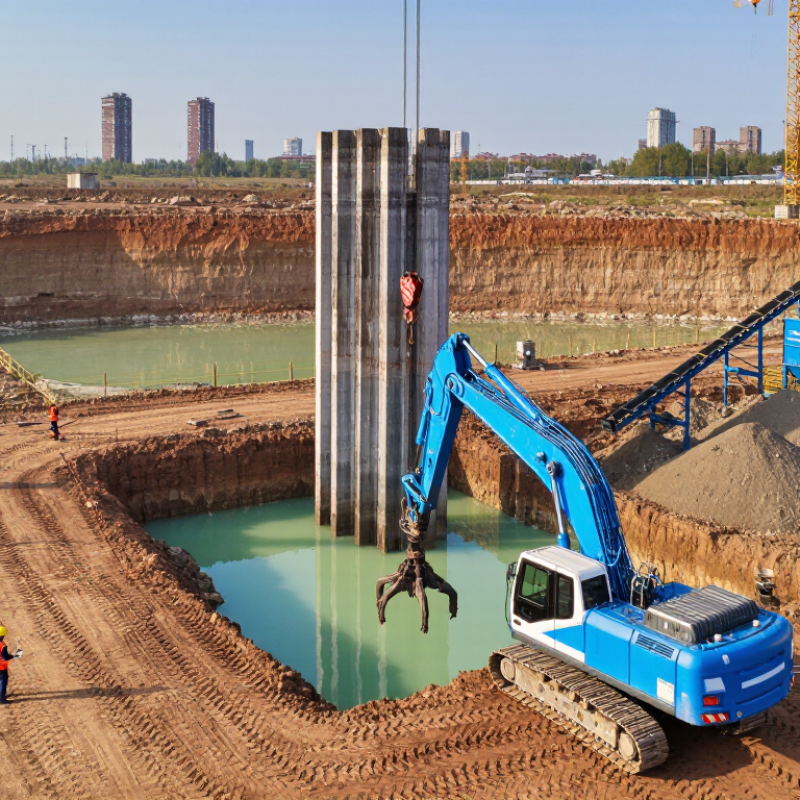
Hydraulic grabs suit many urban sites with soft clay, silt, or sand. Their jaws remove soil panel by panel, while slurry supports the trench. They are relatively simple to mobilize. But in dense gravel or hard rock, progress can slow, and trench alignment needs close monitoring.

Hydromills, also called trench cutters, use rotating wheels to excavate tougher ground. They can provide better verticality at depth, though they need more space, power, and specialist slurry treatment. CIRIA’s C760 guidance on embedded retaining walls emphasizes ground conditions and construction tolerances as key design inputs. That matters in practice: a narrow site may favor a grab even when a cutter could excavate faster. No machine wins everywhere.

Match the equipment to the deepest panel, not just average depth. EN 1538, the European execution standard for diaphragm walls, sets project-dependent requirements for wall geometry; a 1% verticality deviation is often used as a screening benchmark, not a substitute for the project specification. Check trial-panel results, spoil handling, and slurry testing before committing. A grab may look economical on paper. I would still question that choice where cobbles or obstructions are likely.

How to Choose the Right Diaphragm Wall Equipment

Compare typical trench depth capabilities by equipment type

These indicative ranges show common applications, not guaranteed limits. Actual achievable depth depends on ground conditions, wall dimensions, equipment configuration, and site constraints. Compare these factors alongside accuracy, production needs, and project cost when selecting equipment.

Match Equipment Capacity to Panel Design and Depth

How to Choose the Right Diaphragm Wall Equipment
Match Equipment Capacity to Panel Design and Depth

Panel width, thickness, and depth should guide equipment selection. A narrow panel in confined ground may need a compact grab and careful crane positioning. Deeper panels demand more than extra reach: check the machine’s rated capacity, cutting or grabbing performance, and ability to maintain verticality. Depth matters. A tool that handles the upper layers smoothly may struggle when dense soil or obstructions appear below.

Match the equipment to the ground investigation, not just the drawing. Soft deposits may suit grab excavation, while hard strata can require cutting equipment with suitable power and support systems. Also check whether the crane can lift the tool, slurry, and excavated material safely at the planned working radius. Allow space for spoil handling and slurry circulation; these often constrain production before excavation does. A tidy calculation can still miss site access or changing ground conditions. Recheck assumptions as panels progress, and adjust the setup when excavation records show a real difference.

Check Safety, Productivity, and Support Requirements

How to Choose the Right Diaphragm Wall Equipment
Check Safety, Productivity, and Support Requirements

Choosing equipment starts with the actual site, not a catalogue headline. Check wall depth, panel dimensions, soil conditions, groundwater, and available headroom. A grab or cutter must suit the ground and the crane’s rated capacity. Ask for documented lift charts and clear operating limits. Small details matter.

Safety features deserve close inspection. Look for reliable emergency stops, visibility around the work zone, stable setup requirements, and accessible maintenance points. Confirm that operators can inspect ropes, hoses, and connections without unsafe workarounds. Paper specifications rarely show the whole picture. Watch the equipment operate, if possible, and ask how routine checks are recorded.

Productivity depends on the full process, not just excavation speed. Consider cycle times, tool changes, slurry circulation, and how spoil is handled between panels. A fast machine may still lose hours if support systems cannot keep pace. Check parts availability, technician response times, operator training, and maintenance intervals. Be candid about weak spots: a tight site or unfamiliar ground can reduce expected output, and estimates may need revision after initial panels. Reliable support should include practical troubleshooting, not only a manual.

How to Choose the Right Diaphragm Wall Equipment — Check Safety, Productivity, and Support Requirements

Equipment type Best suited to Typical capability Productivity considerations Key safety checks Support and site requirements
Mechanical grab Many conventional diaphragm wall excavations in soils and weathered ground, where obstructions and rock are limited. Commonly used for panel widths of about 0.6–1.5 m. Achievable depth depends on the rig, ground conditions, and grab configuration. Can be efficient in excavatable soils. Progress may slow in dense gravel, hard layers, or ground containing obstructions. Check crane capacity and load charts; inspect ropes, grab, and lifting gear; maintain an exclusion zone around suspended loads. Requires stable working platforms, suitable guide walls, and properly managed support slurry where required by the excavation method.
Hydraulic grab Projects needing controlled excavation in a range of soils, especially where panel geometry and verticality require close monitoring. Available configurations suit different panel widths and depths; confirm limits against the specific rig, grab, and ground investigation. Performance depends on soil strength, grab size, slurry management, and the time needed to clean and verify each panel. Inspect hydraulic hoses and connections; follow the equipment-specific operating procedure; monitor lifting operations and keep personnel clear. Needs a stable platform, guide walls, slurry storage and testing, and a plan for handling excavated spoil.
Hydraulic diaphragm wall cutter (hydromill) Deep walls, hard or variable ground, and projects with demanding verticality requirements or where cutting through rock is necessary. Some cutter systems are designed for depths exceeding 50 m; actual depth and panel dimensions are equipment- and project-specific. Can provide continuous cutting and useful real-time alignment data. Overall output is affected by rock strength, spoil removal, slurry treatment, and cutter maintenance. Verify cutter and crane capacity, manage high-pressure hydraulic systems, monitor slurry lines, and establish exclusion zones for lifting and handling operations. Requires substantial crane and platform capacity, continuous slurry circulation, desanding and treatment facilities, and experienced operating and maintenance staff.
Grab with chiselling or other obstruction-removal tools Localized obstructions or hard inclusions that cannot be removed efficiently by the primary excavation tool alone. Capability varies with the obstruction, tool, and base excavation equipment; assess the method using site-specific ground information. May resolve isolated obstructions but usually adds handling and excavation time. Frequent obstructions can make a different primary method more suitable. Use an engineered lifting plan for tools and attachments; inspect connections; control vibration and keep workers outside the operating area. Allow space and time for tool changes, spoil handling, slurry control, and any required obstruction-treatment or disposal procedures.

Selection note: Capability and production vary with ground conditions, panel dimensions, wall depth, slurry properties, equipment configuration, and operator experience. Confirm the method using the site investigation, equipment data, temporary works design, and project-specific risk assessment.